Buying Watches as an Investment? Here's What Most People Get Wrong About Storage
The watch market has changed significantly over the last decade. What was once a niche hobby for horological purists has become a mainstream alternative asset class — with auction records broken regularly, waiting lists measured in years, and a thriving global secondary market.
But most people who buy watches with one eye on value make a critical mistake. They focus entirely on what they buy, and almost none on how they look after it. And that's where real money gets quietly lost.
What Actually Drives Watch Resale Value
When a watch is sold on the pre-owned market — through Christie's, Sotheby's, Chrono24, Bob's Watches, or a private dealer — the price achieved depends on several factors beyond the reference and movement. Condition and completeness are two of the most significant variables, and both are entirely within your control.
Condition
"Condition" in watch terms means the physical state of every surface: the case, the crystal, the dial, the bracelet or strap, and the movement. Watches are graded on a spectrum from "mint" or "new old stock" (unworn, perfect) through to "heavily worn" or "polished" (a significant negative). Every grade between those points has a material effect on price.
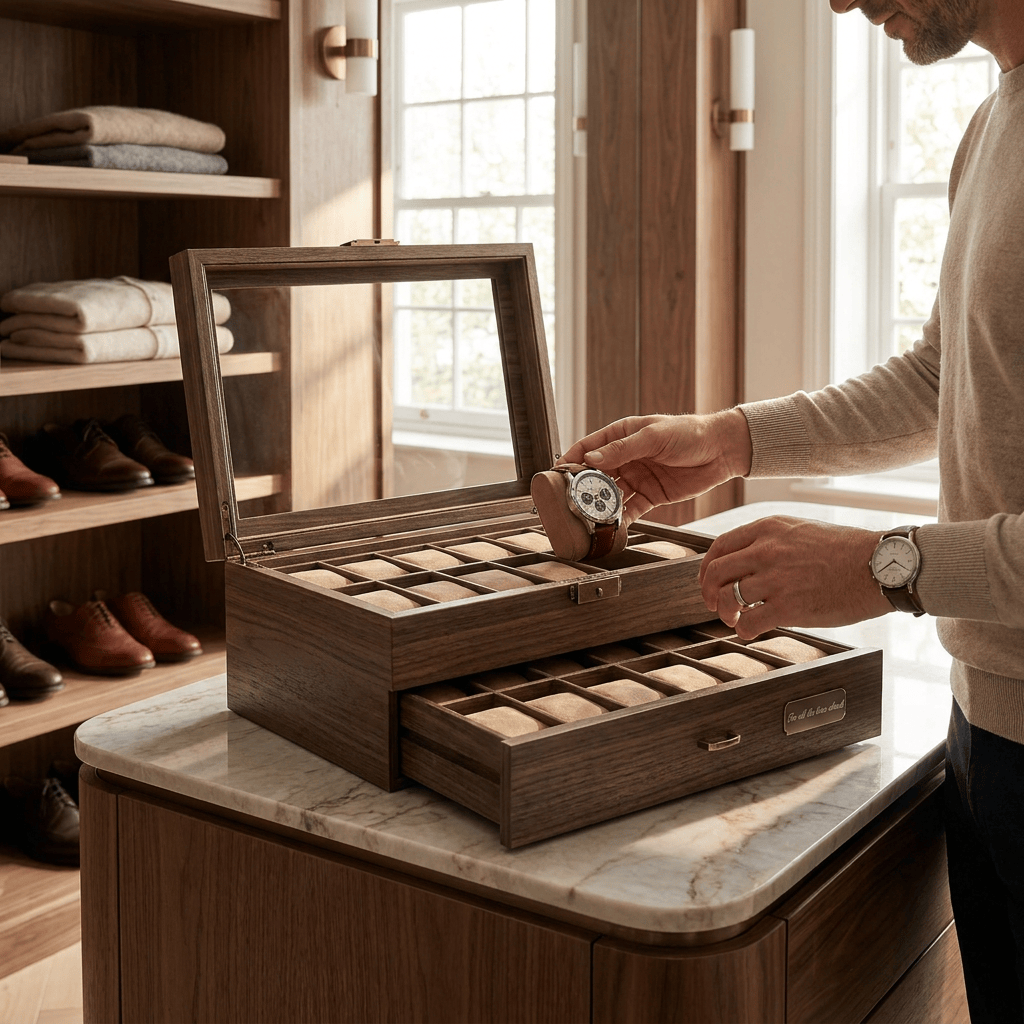
The watches that hold condition are the ones stored properly. Individual padded compartments. No contact with other objects. Away from dust, humidity, and light. It sounds basic — because it is — but the number of collectors who still keep valuable pieces in a drawer or loose on a shelf is surprisingly high.
Our Heritage 15 — Espresso Black (£229) is handcrafted from solid thick-walled wood with individual lockable storage. For a serious collector with investment-grade pieces, this is the appropriate standard. The Heritage 18 — Chestnut Brown (£229) offers the same heirloom quality for larger collections.
Completeness: The "Full Set" Premium
This is the factor that surprises most new collectors. A watch sold with its original box, inner and outer packaging, warranty card, hang tags, chronograph pushers, extra links, and all documentation — known in the trade as a "full set" — commands a premium that can reach 20–40% over the same reference sold without.
On a watch worth £10,000, that's £2,000 to £4,000 of value sitting in a cardboard box. Throw the box away, lose the warranty card, misplace a link — and that money disappears silently.
Store everything. Original boxes, inner trays, documents, spare links, tools. Keep them together, undamaged, and clearly associated with the correct watch. This habit alone, maintained consistently, is worth significant money over a collecting lifetime.
Service History Matters More Than Most Buyers Realise
A watch with documented service history — records showing authorised servicing at appropriate intervals — is a more confident purchase for a buyer. It signals that the movement has been properly maintained, that worn components have been replaced, and that the seller is a careful, knowledgeable owner.
Watches without service records are discounted on the secondary market, sometimes heavily. The buyer has no way to assess the internal condition and prices accordingly — low — to account for the unknown.
Service your watches on schedule (typically every 5–7 years for most movements). Keep every receipt, every job card, every document from every service. Store them with the original papers.
The Polishing Problem
One of the most value-destructive things you can do to a luxury watch is have it polished. Professional polishing removes metal from the case surfaces, softening the crisp edges and angles that define the original design. On Rolex, Patek Philippe, Audemars Piguet, and most other major brands, an obviously polished case is a significant negative to informed buyers.
Scratches and honest wear are often preferable to polishing, particularly on sports models. A watch with original surface finish — even with light wear — is more valuable to collectors than one that's been refinished to a mirror shine.
The lesson: protect the original surface from unnecessary contact and scratches through proper storage, and resist the urge to have it "cleaned up" by polishing.
Travel: The Highest-Risk Moment
The most common point of accidental damage to a watch is during travel. A valuable piece packed loose in a bag, rolling around in checked luggage, or tucked into a toiletry case alongside hard objects is taking a genuine risk every trip.
A proper travel case is not an optional accessory for someone treating watches as investments — it's a basic requirement. The Voyage 6 — Oxford Navy (£79) holds six watches in individual padded slots within a sleek professional case. The Voyage 6 — Desert Tan and Voyage 6 — Bordeaux Red offer the same protection in alternative colourways.
For travelling with one or two watches, the Journey 3 Watch Roll (£49) is compact, padded, and takes almost no space in a bag.
The Summary: What Serious Collectors Do Differently
- They store every watch individually in padded, closed storage from day one
- They keep original boxes, papers, and documentation in perfect condition
- They service on schedule and keep every record
- They never polish unless absolutely necessary
- They use dedicated travel cases, every trip, without exception
- They treat storage quality as proportional to watch value
None of this is complicated. It's consistent habit applied over time — and the financial difference it makes, measured over a collection and a collecting lifetime, is substantial.
Browse our full range of collector-grade watch storage at LuxWatchBox.co.uk